
A day trip to Évora, Portugal, means Roman ruins, a bone chapel & a 7,000-year-old stone circle. Here’s why one day isn’t enough and how to explore Evora properly.
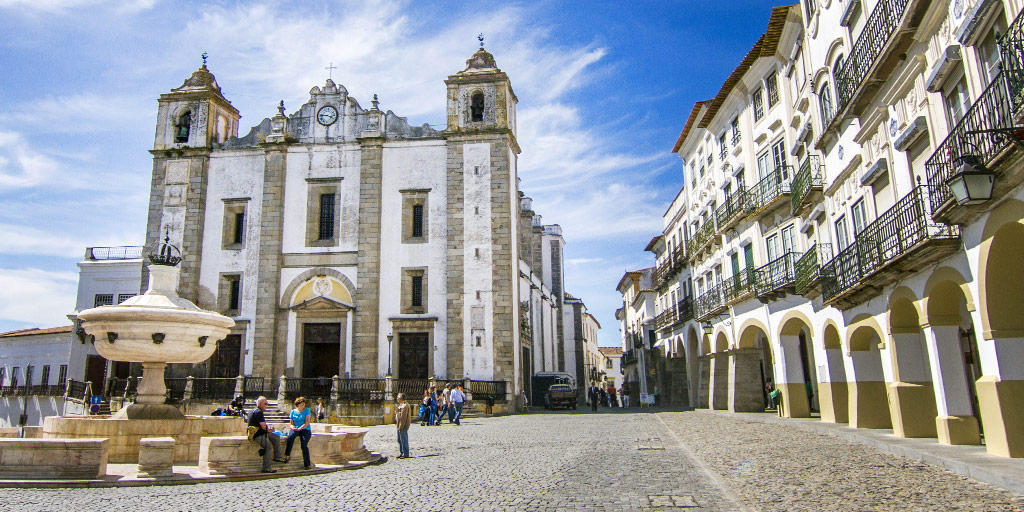
Évora is the kind of place that can ruin your Portugal itinerary. Not because anything goes wrong, but because you arrive planning to give it an afternoon and leave wondering why you didn’t set aside a week for the city.
Roman ruins, a bone chapel, cobblestone lanes the color of old paper, and some of the best food in Portugal all hide in eight-seat rooms you’d walk straight past if you didn’t know any better. This walled city in the Alentejo has become one of the most popular day trips from Lisbon, and is increasingly becoming a destination people build their whole Portugal travel experience around.
So why don’t I recommend a day trip to Évora? Because I made that mistake, you don’t have to. Read on.
Évora Quick Trip Planner
Best for: History lovers, food obsessives, and families who want a UNESCO city that’s walkable, weird, and not yet Disneyfied.
Don’t-miss sight: The Capela dos Ossos (Chapel of Bones), a chapel decorated with the bones of roughly 5,000 people. Macabre, unforgettable, and oddly peaceful.
Best meal in town: Botequim da Mouraria – eight counter seats, no reservations, the owner recites the menu by memory. Arrive early, or you’re out of luck.
Best day-trip add-on: The Almendres Cromlech, a 7,000-year-old stone circle 8 miles (13 km) west, older than Stonehenge and completely free.
Where to stay (splurge): Convento do Espinheiro, a 15th-century convent turned five-star hotel.
Where to stay (value): Heaven Inn Évora, central and a genuine bargain.
How long you need: Two days minimum. One day is a tease. (Yes, I’m aware that’s the whole point of this article.)
Getting there: Around 90 minutes by train or bus from Lisbon, or about 85 minutes by car. Book a guided walking tour here to skip the guesswork.
Our Day Trip to Évora, Portugal
Table of Contents
Pro Tip: No car? You don’t need one. Both the train (Comboios de Portugal) and the express bus (Rede Expressos / FlixBus) make the route from Lisbon to Évora in around 90 minutes, dropping you a 10-minute, 0.3-mile (500 m) walk from the old town. The train is more scenic; the bus runs more often.
Our first visit to Évora came at the tail end of a tour through Southern Portugal, when we were sun-drugged and useless after a few days of being professional beach bums in the Algarve. We had exactly one day left before flying home to Canada, and instead of doing the sensible thing, lying horizontal on the beach until our flight, we decided to drive into the medieval heart of the Alentejo.
Évora sits less than two hours from Cascais and nearby Lisbon. We’d rented a car for our family road trip through Portugal, which made the whole travel experience easy, and because most of Évora’s attractions are packed neatly inside the old city walls, we figured a day trip would be more than doable.
It was not.
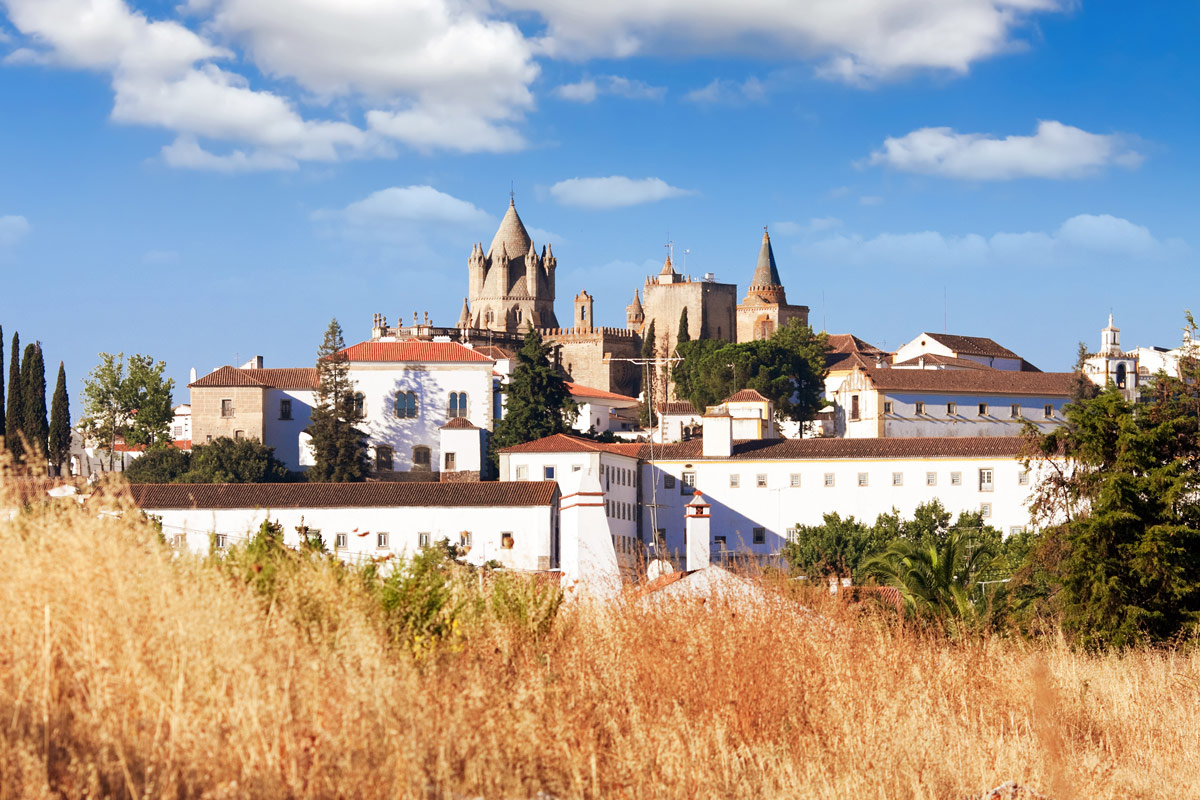
We left Lisbon early and took the toll road to dodge traffic, a straight shot on the highway from our family-friendly base in Cascais, no GPS required. Before long, the walled city rose out of the plain like something straight out of a movie. Determined to avoid the parking circus we’d survived in Sintra, we grabbed a spot in one of the many lots just outside the walls and walked in.
About Évora, Portugal
Évora is roughly 5,000 years old, which means it was already ancient when most of Europe’s “old towns” were a gleam in a Roman surveyor’s eye. It started life as Ebora, the regional capital of the Lusitanians. It was conquered by the Romans in 57 BC, then changed hands again when the Moors took it in 715, the same wave that helped lead to the plethora of castles in Sintra. The Christians recaptured it in 1165, and between 1385 and 1580 it became Portugal’s capital of culture under the Manueline kings.
All that history left a mark. The old town, still wrapped in medieval walls, is a tight, walkable maze of Roman, Gothic, Manueline, and Baroque architecture, all bumping shoulders within a few minutes’ walk of each other. It’s the reason UNESCO gave the whole city World Heritage status, and the reason it keeps landing on lists of the most liveable cities in Portugal.
The catch? Everyone’s figured that out. Évora has had a serious tourism boom, and a day trip can mean elbowing through big crowds, especially on weekends and holidays. Plan accordingly.
If you want to dive into the city’s stories without doing a deep dive into Portuguese architectural history yourself, this half-day walking tour is the easy button. A good guide will tell you more in two hours than I could in two weeks.
Getting to Évora From Lisbon
Évora sits about 80 miles (130 km) southeast of Lisbon, and you’ve got three honest options to get between the two cities:
- By car (~85 minutes): The fastest and most flexible, and essential if you want to reach the Almendres Cromlech or the surrounding wine country. Park outside the walls. The old town is not where you want to test your reversing skills. This is where I get my car rentals from. It’s never let me down.
- By train (~90 minutes): Comboios de Portugal runs several services a day from Lisboa Oriente. It’s the scenic, roomy choice, and Évora’s station is a flat 0.3-mile (500 m) stroll from the historic center. You can book tickets on their website here.
- By bus (~90 minutes): Rede Expressos and FlixBus depart from Sete Rios. The bus departures are more frequent than the train, and it drops you right at the edge of the walled city.
One serious warning: Alentejo summers get quite hot. Temperatures regularly push past 104°F (40°C) in July and August, and Évora’s stone streets bounce that heat right back at you. Start your days in the city early, carry water, and treat the midday hours the way the locals do, indoors, ideally with a cold drink in your hand.
Things to Do in Évora, Portugal
A few years ago, Évora was a quiet town. One that was far less touristy than the Algarve or Sintra. That off-the-radar feeling has faded, but the city deserves the attention. Here’s what to actually do with your time in Évora.
Roman Temple (Temple of Diana)
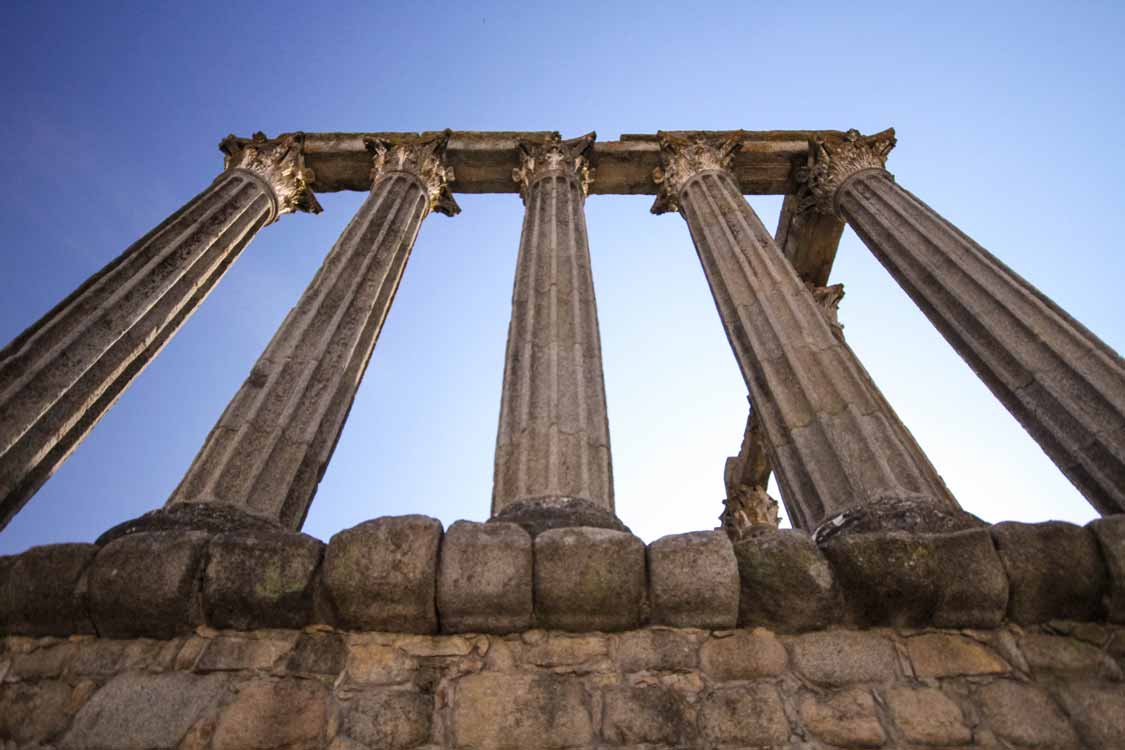
I spotted the Roman temple almost the moment that my family cleared the medieval walls: fourteen Corinthian columns standing on a granite base. For something built in the 2nd or 3rd century AD, it’s in remarkable condition. It’s popularly called the Temple of Diana, though there’s zero proof it was ever dedicated to the goddess of the hunt. It’s a name that stuck because it sounds better than “the temple that no one knows anything about.”
Here’s the gloriously grim reason that this temple survived generations of battles for the ownership of Évora: in the Middle Ages, the locals walled it up and used it as a slaughterhouse. That casing protected the structure for centuries, so when it was finally excavated, much of the original character was intact. Slaughterhouse to showpiece, the story of Évora in a nutshell.
Évora Cathedral (Sé)
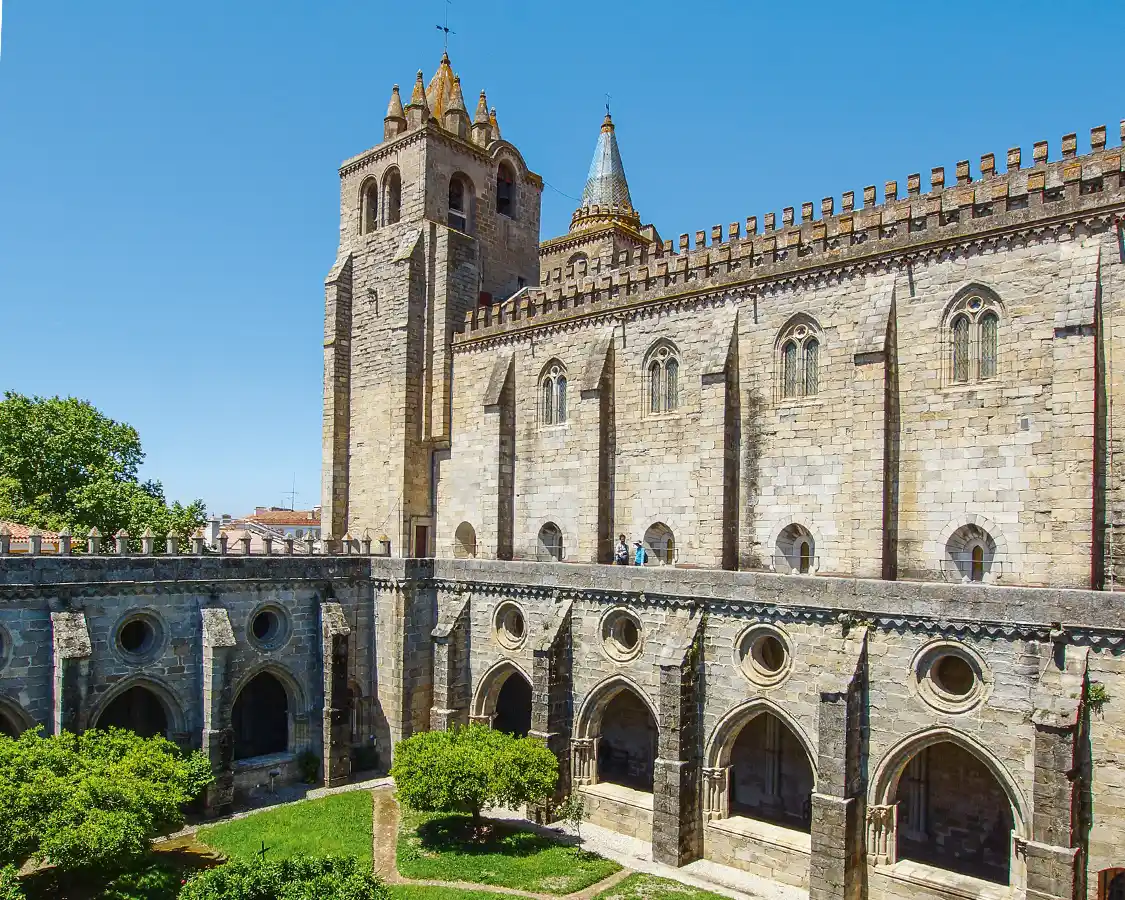
Across from the Roman Temple sits the Sé, a cathedral that took 50 years to build and looks, from the outside, more like a fortress than a place of worship. Its weathered granite facade and two mismatched towers, one turreted, one capped with a blue cone, won’t win any beauty contests, but stop and study the portal between them, where a beautifully sculpted set of Apostles is keeping watch.
Inside, the Sé finally settles into traditional Catholic elegance: an 18th-century high altar, a polished marble chancel, and a treasury that doubles as a museum of sacred art, packed with gold, silver, and the kind of priceless objects that warrant a little extra security. Climb to the rooftop for one of the best views in the city, then wander the cloisters to appreciate just how big this fortress-church really is. Pair it with a visit to the magnificent monasteries of Portugal, and you’ll start to understand the country’s obsession with stone and faith.
Praça do Giraldo
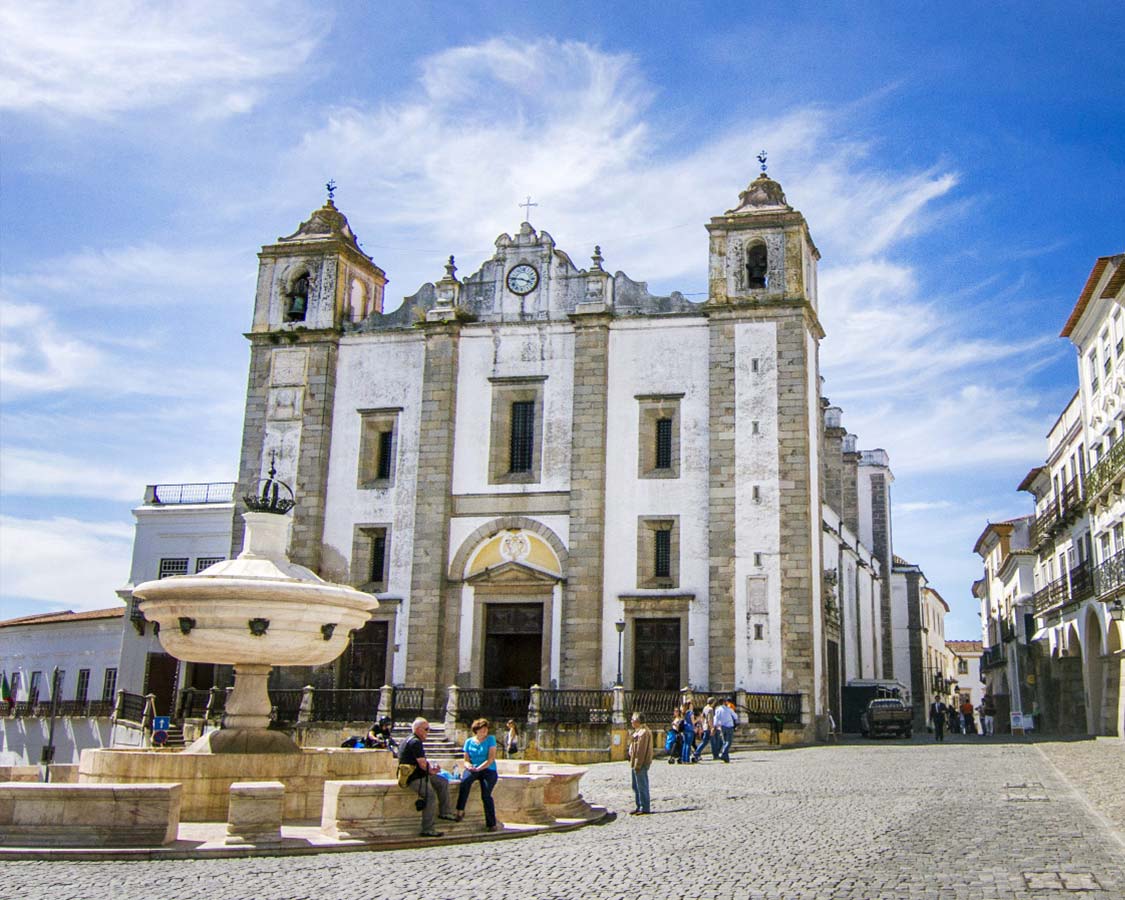
After the cathedral, we drifted down Rua 5 de Outubro, a lane lined with shops selling Alentejo handicrafts and a heroic amount of cork, the region’s signature material. The local craftspeople have turned cork into everything from coasters to handbags. Six-month-old Cohen could not keep his hands off the merchandise.
Christina and I kept finding soft cork playthings tucked into the stroller that we would have to sheepishly carry back to the vendors. The products spilled out into Praça do Giraldo, Évora’s grand main square, anchored by a marble fountain that’s been the city’s living room for centuries. When you’re there, grab a coffee from Café Arcada, watch the world go by, then duck out of the sun toward the Church of St. Francis.
Church of St. Francis (Igreja Real de São Francisco)

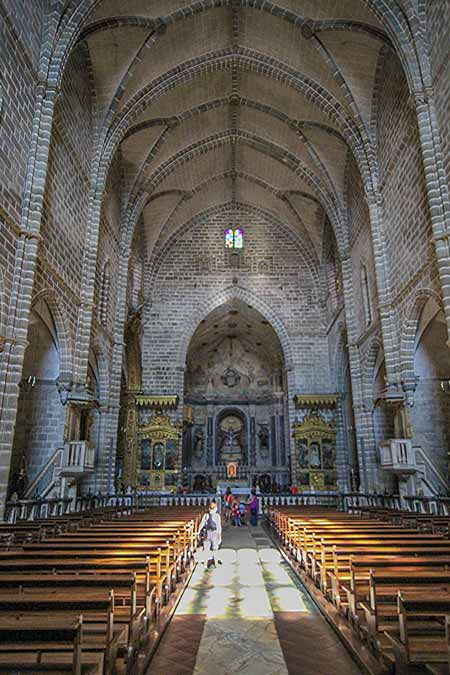
Built between 1475 and 1550, this Gothic church is enormous. It’s built with a single vaulted nave that’s the largest of its kind in all of Portugal. But almost nobody comes for the nave. They come for the small room tucked behind the altar, which is where Évora gets strange in the best possible way.
The Bone Chapel Of The Church Of St. Francis (Capela dos Ossos)
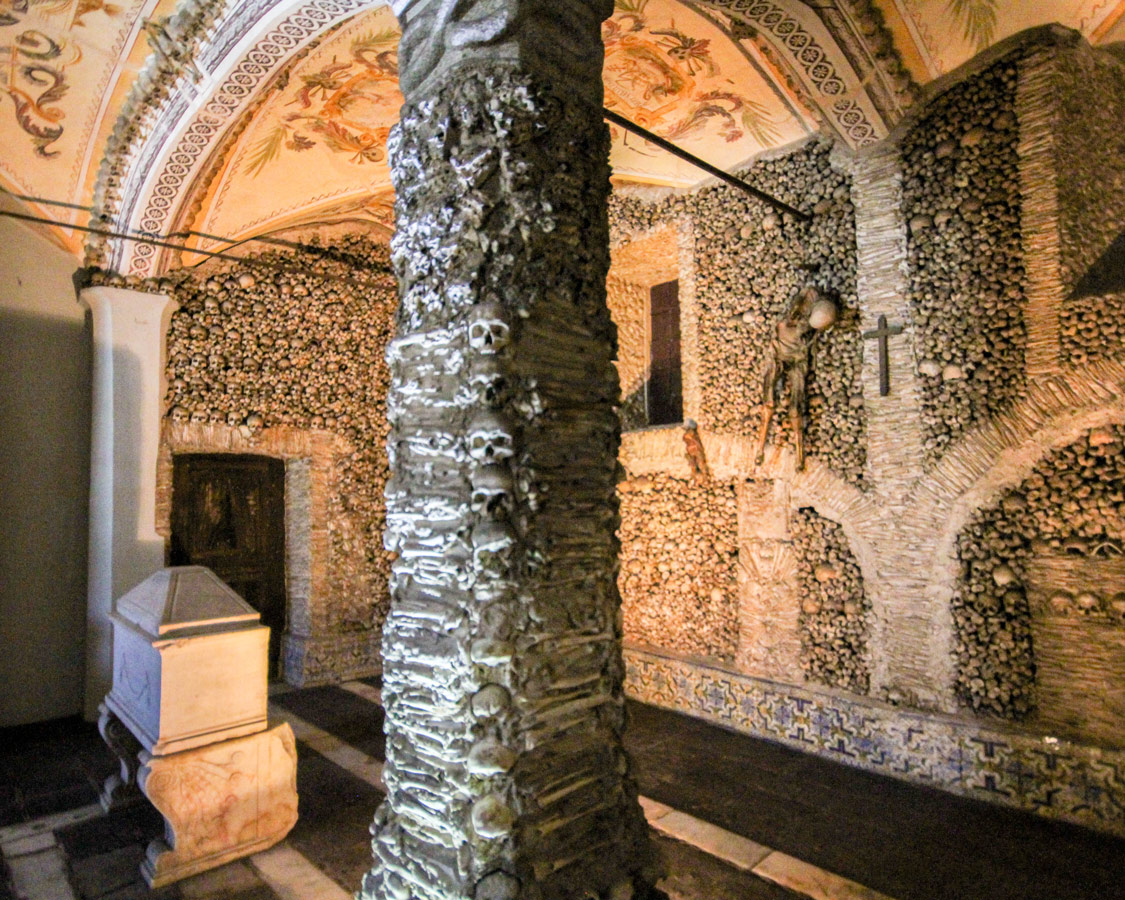
Welcome to the Chapel of Bones, possibly the most memorable room in Évora and definitely the most unsettling.
Using human bones as décor sounds macabre, because it is, but it was once surprisingly common. From Paris to London to Lima, ossuaries were a practical answer to overcrowded graveyards in times of plague and famine. Évora’s version was built by a 16th-century monk with a deliberately heavy-handed message: a reminder of how fleeting life is. The inscription over the door doesn’t mess about. It reads, “Nós ossos que aqui estamos, pelos vossos esperamos” – “We bones that are here await yours.” Cheerful stuff.
Inside the bone chapel are the bones of roughly 5,000 people, exhumed from the city’s overflowing graveyards. The skeletal remains line every wall and all eight columns. Three small windows let in just enough light to make the whole thing feel like a held breath. And in case the message wasn’t clear, two desiccated bodies hang from a chain on one wall, one adult, one child.
It’s a genuinely beautiful, albeit heavy, place. Those who scare easily, or who are visiting Portugal with young kids, should know what they’re walking into. For my part, I’ll admit I was quietly relieved that our one-year-old, C, was far too young to understand that the wall was, in fact, made of people. In retrospect, though, it’s possible that this is the moment that led Cohen to absolutely hate horror movies.
Church of Our Lady of Grace (Igreja da Nossa Senhora da Graça)
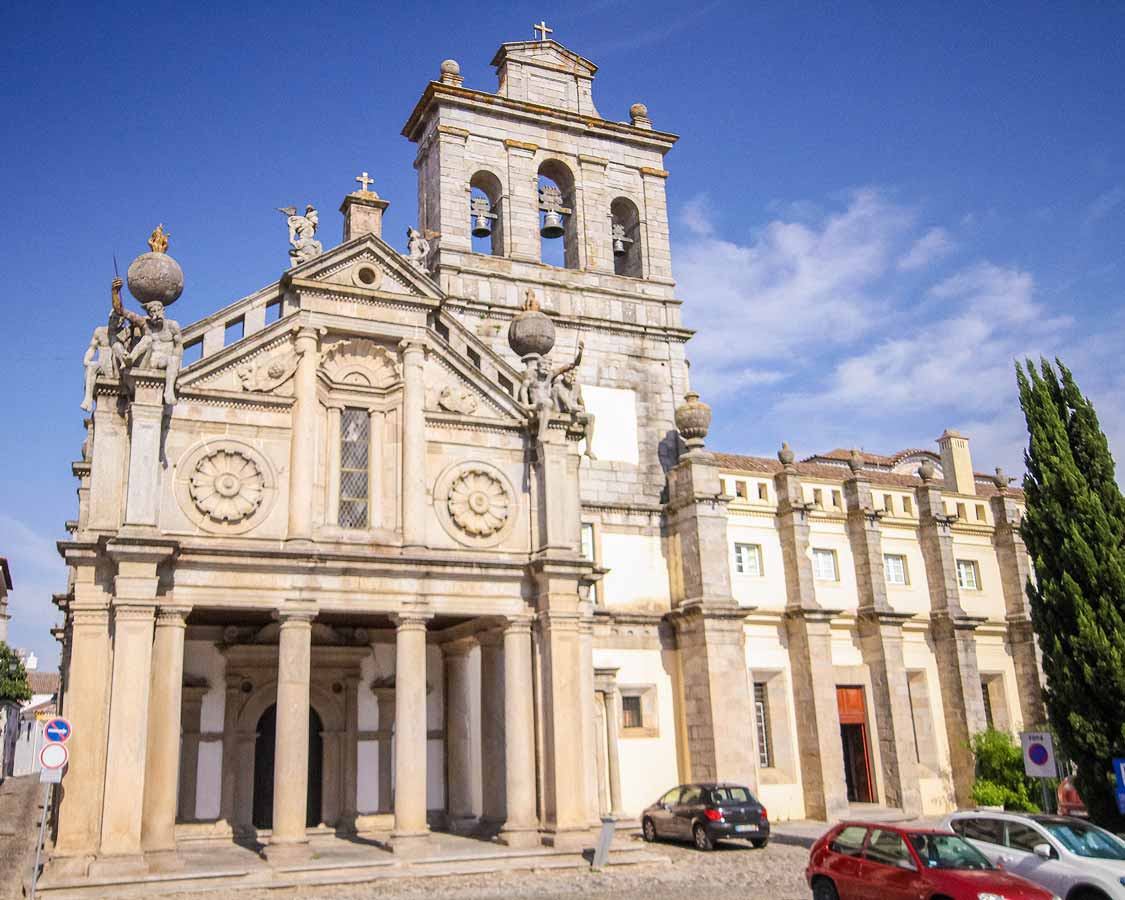
Walking back toward the walls along Rua da República, we took a pause at the Church of Our Lady of Grace. What stops everyone here is the four enormous stone figures perched on the Baroque facade, each apparently straining to hold up a massive stone globe. They’re nicknamed Os Meninos da Graça, the “Children of Grace.”
Aqueduct of Silver Water (Aqueduto da Água de Prata)
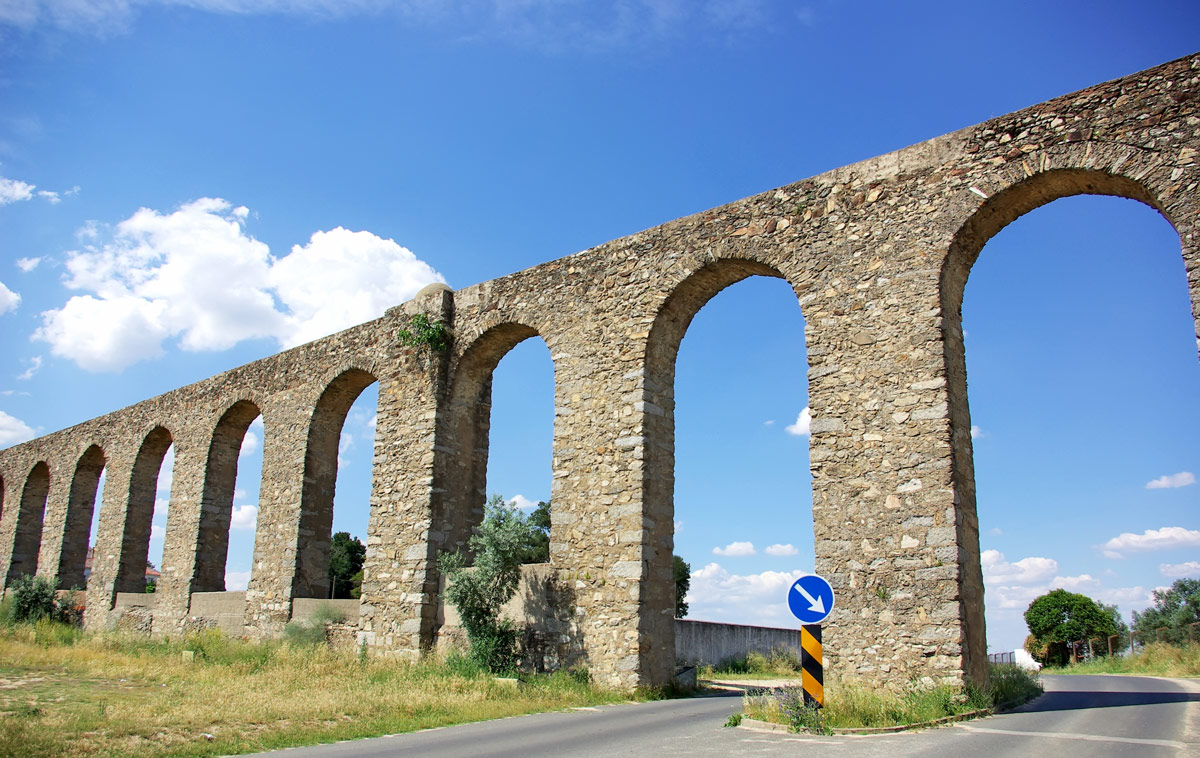
Head just outside the walls for the Aqueduct of Silver Water, completed in 1537 and designed by Francisco de Arruda, the same architect behind Lisbon’s iconic Tower of Belém. We’d already seen our share of Portuguese aqueducts by this point, but this one has a party trick: at its tail end, where it runs into the city, houses, shops, and cafés have been built directly into the arches, like barnacles on a very dignified whale. It was pretty wild to realize that people have been living inside this aqueduct for nearly 500 years.
Things To Do Beyond the Walls of Évora
The Almendres Cromlech
Here’s the attraction that should single-handedly talk you out of a day trip to Évora.
About 8 miles (13 km) west of the city, down a dirt road through a mess of olive and cork trees, stands the Almendres Cromlech. 95 granite stones arranged in two great ellipses on a gentle slope. It’s roughly 7,000 years old, which makes it about 2,000 years older than Stonehenge. Let that sit for a second. While Stonehenge gets the crowds, the gift shops, and the rope barriers, this older, and arguably more beautiful cousin sits out here in the Alentejo countryside, almost entirely on its own.
And here’s the kicker: it’s completely free, open at all hours, and, astonishingly, unfenced. There are no ropes, no ticket booth, no gift shop. You can walk right up and put your hand on a stone that someone raised before the invention of the wheel. For an adventure-loving family like ours, that’s not a museum exhibit. That’s time travel we could touch.
The trade-off is access: there’s no public transport out to the Almendres Cromlech, so you’ll need a rental car or a guided megalithic tour. Before you go, the Centro Interpretativo do Megalitismo in Évora makes a great primer. And this, right here, is why one day in Évora simply does not work for most families. You cannot do the bones, the cathedral, the food, and a 7,000-year-old stone circle before the last train leaves.
Where to Eat in Évora
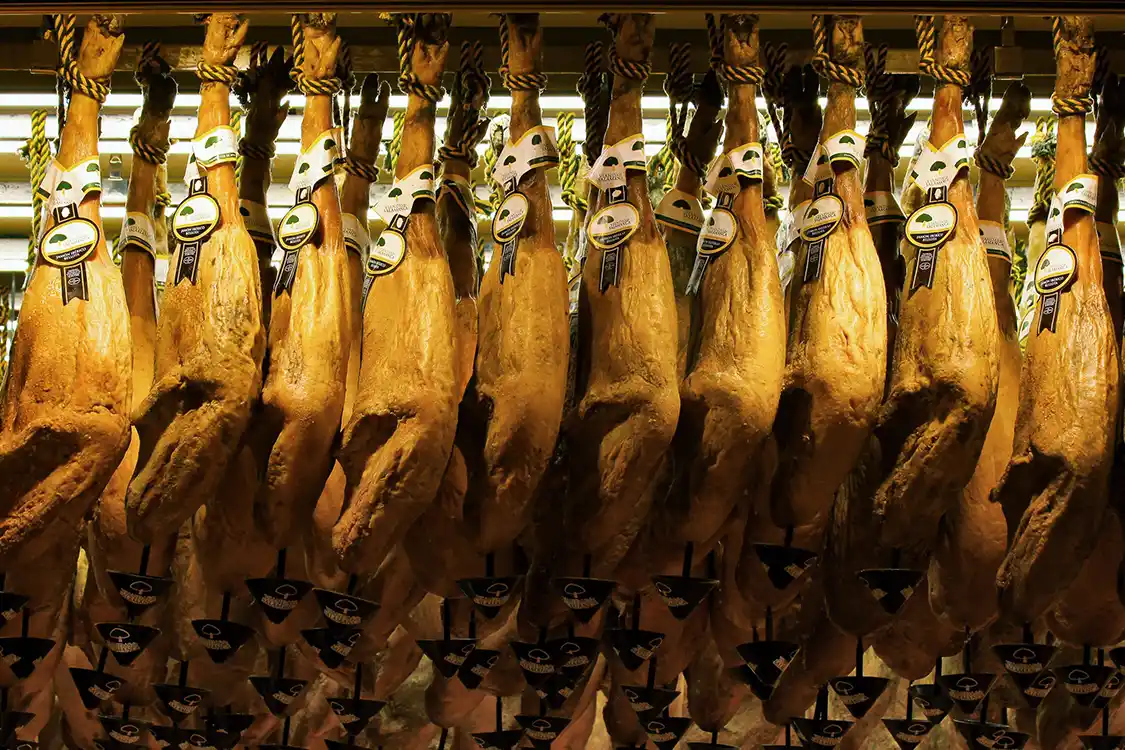
Évora is full of incredible food. In fact, I’d argue that the food here is some of the best in Portugal. So where should you eat in Évora? Here’s my honest take.
A confession first. On a single-day trip, we didn’t get to eat our way through town, which is, again, precisely the argument of this whole article. But the Alentejo is one of the great food regions of Portugal, built on black Iberian pork (porco preto), bread-thickened açorda and migas, pungent queijo de Évora sheep’s cheese, slow-cooked lamb, and big, generous glasses of red wine. What I’ve written here is all from deep research and conversations with the many travelers I’ve talked with who have spent a tremendous amount of time in the city.
Here are the Évora restaurants where I’d plant myself, and where locals and the genuinely food-obsessed keep pointing to:
- Botequim da Mouraria is the one restaurant everyone whispers about. Eight seats at a counter, no tables, no reservations, no website worth speaking of. The owner, Domingos, recites the menu out loud while his wife, Florbela, cooks the food behind him: wild asparagus, Alentejo prosciutto, briny clams, whatever’s good that day. Show up right when it opens, or you’ll find a “we’re full” sign and leave with a broken heart. The restaurant is closed on Sundays and Mondays.
- Restaurante Fialho is a grand old institution. A third-generation, family-run tavern that’s been doing classic Alentejo cooking for decades. Think broad beans with ham, lamb, pork tenderloin with apple, and rabbit rice. Book ahead; this is where Évora celebrates.
- Taberna Típica Quarta-feira is a beloved, tiny, traditional restaurant routinely called the best meal of people’s entire trip to Portugal. Reserve a table ahead of time, or you’ll leave disappointed.
- Cavalariça Évora is for a fancier night. A Michelin-recommended restaurant that serves modern sharing plates, set inside the 14th-century Palace of the Dukes of Cadaval, right by the Roman Temple. Local Alentejo ingredients, cosmopolitan attitude.
- Enoteca Cartuxa is for those who cannot come to one of Portugal’s premier wine regions and not drink the wine. This is the spot to pair local Alentejo bottles with regional plates without pretension.
Click any name above for current hours, menus, and to book, because, frustratingly for a control freak like me, the best Évora restaurants don’t hold a table for love nor money. You just have to show up hungry and on time.
Don’t Make a Day Trip to Évora
So here’s the payoff to that contrarian title. All of these experiences add up to a day trip to Évora that is, genuinely, unforgettable. Visiting this walled city was one of the highlights of our entire trip to Portugal.
And that’s exactly the problem. You see, one day in Évora is a tease.
This is a city that deserves a quiet morning coffee in the square before the tour buses arrive, a long lunch at a counter where the owner recites your options by memory, an afternoon out at a stone circle older than recorded history, and a dinner that rolls into a second bottle of Alentejo red.
For those who aren’t traveling with a baby, Évora deserves the old town at night, when the crowds thin and the floodlit cathedral is at its mystical best. A day trip gives you the highlights reel. An overnight gives you the chance to feel the city
At only 90 minutes from Lisbon, Évora is almost too easy to day-trip, and that’s the trap. If you’re planning something longer, like ten days in Portugal, turn this into an overnight (or two) and use it as a base for the wider Alentejo region. You’ll thank me.
Where to Stay in Évora, Portugal
I did deep research on where we’d stay on our return trip to Évora. And good news, the best local hotels are still going strong. Here’s where to base yourself, from former convents to backpacker bargains.
Luxury Hotels in Évora
- Convento do Espinheiro, A Luxury Collection Hotel & Spa, is a 15th-century convent that once hosted Portuguese kings. It’s now a 92-room, five-star stunner set in eight hectares of gardens about a 10-minute drive outside town. The hotel features two restaurants, a spa with a Turkish hammam, a pool, and a Gothic cistern where they pour you local wine. It’s currently ranked the top cultural hotel in Évora, and it earns its place.
- Pousada Convento de Évora (dos Loios) is another converted convent, this one parked right in the historic center, steps from the Roman Temple. Part of the Pestana Pousada collection, it pairs centuries-old bones with modern comfort, a pool, and a location you genuinely cannot beat.
- M’Ar De Ar Aqueduto is a polished five-star hotel built around the Água de Prata aqueduct. It features a garden, an outdoor pool, an indoor heated pool, and childcare services that make it an excellent pick for families.
Boutique & Mid-Range Hotels in Évora
- Vitória Stone Hotel is a contemporary design hotel with a stone-clad interior inspired by the region’s megalithic culture. If the Almendres Cromlech grabs you the way it grabbed us, this is the thematic home base.
- ADC – Albergaria do Calvário is a consistently top-rated boutique hotel just inside the walls, known for warm service and one of the best breakfasts in the city.
Budget Hotels & Hostels in Évora
- Heaven Inn Évora is central, friendly, and one of the best deals in town, a 330-yard (300 m) walk from the Cathedral. Now run as a hostel, it’s a reliable budget pick.
- Old Évora Hostel is a popular, easygoing hostel with a pool and a handful of comfortable rooms. This one is ideal for backpackers and budget-minded families who’d rather spend their money on lamb and wine.
Plan the Rest of Your Portugal Trip
If Évora has you rethinking your whole Portugal itinerary (it should), keep going:
- The Best Day Trips From Lisbon, Portugal
- The Magnificent Monasteries of Portugal: Alcobaça, Batalha & Tomar
- Fátima, Ourém & Óbidos: A Perfect Central Portugal Road Trip
- The Fairy-Tale Castles of Sintra, Portugal
- Exciting Things to Do in Lisbon With Kids
Frequently Asked Questions
Absolutely — it’s one of the most historically layered cities in Portugal, with Roman ruins, a famous bone chapel, a UNESCO-listed old town, and a 7,000-year-old stone circle nearby. The only real mistake is not giving it enough time.
Two days is the sweet spot. One day lets you see the headline sights inside the walls but forces you to skip the food, the nightlife, and the Almendres Cromlech. Two days lets you actually enjoy the place instead of speed-running it.
If you can only do one and you love fairy-tale palaces and lush forests, choose Sintra. If you prefer ancient history, fewer crowds, extraordinary food, and a city you can actually walk end to end, choose Évora. They’re very different days out — Sintra is theatrical, Évora is timeless — and honestly, if your trip allows it, do both on separate days rather than cramming them together.
Yes. The compact, walkable old town is easy with kids, the Roman Temple and aqueduct are genuinely cool to young explorers, and the stone circle at Almendres is a hands-on hit. Just use your judgment at the Chapel of Bones — younger or sensitive kids may find the skeletons and hanging figures intense.
Take the train (Comboios de Portugal from Lisboa Oriente) or the express bus (Rede Expressos / FlixBus from Sete Rios). Both take about 90 minutes and drop you within a short walk of the old town. You won’t need a car inside the city — only for reaching the Almendres Cromlech or the wider Alentejo.
Not easily — there’s no public transport to the site. Your options are a rental car or a guided megalithic tour from Évora. The site itself is free and open at all hours.
Wandering Wagars is a participant in the Amazon Services LLC Associates Program, an affiliate advertising program designed to provide a means for sites to earn advertising fees by advertising and linking to amazon.com, amazon.co.uk, amazon.ca. Amazon and the Amazon logo are trademarks of Amazon.com, Inc. or its affiliates.
James R
Monday 17th of April 2023
Misleading title.
You do recommend Evora as a holiday destination, but for more than a day trip.
Laurel
Monday 23rd of January 2023
We're trying to decide on cutting into our time in Porto to add a day in Evora. Would you recommend this if you had to choose? Such a hard decision!
Kevin Wagar
Thursday 2nd of February 2023
It's always such a hard choice deciding what to see and what to miss out on.
I can't make the decision for you, but I can say that I absolutely loved my time in Evora. And since our visit, the popularity of this city has skyrocketed. I would wholeheartedly visit again.
Patti Connelly
Saturday 7th of May 2022
Great tips; changing my itinerary to include 2 days in Evora
Kevin Wagar
Monday 9th of May 2022
That's wonderful to hear! You will absolutely love your time in Evora.
Jennifer
Friday 6th of May 2022
I am taking my husband for a quick trip to Lisbon (only 4 days, minus travel time) from the States. I had wanted to fit in both Evora & half a day at Sintra but I'm afraid that might be pushing it. If you had to choose one, would it be Evora or Sintra? This will be our first time in Portugal. Thanks!
Kevin Wagar
Monday 9th of May 2022
Hi Jennifer.
This is such a tough question! Personally, I think if I HAD to choose one, I'd go with Sintra. But it's a VERY close race.
Jacob Alexander
Thursday 6th of August 2020
I love the photos you posted, its amazing especially the valley. Thanks for sharing your travels and experience with everyone. Keep it up and continue sharing magnificent journey in Portugal.
Kevin Wagar
Wednesday 12th of August 2020
So glad you love the photos Jacob! Portugal is incredible. We'll be sharing all of our experiences from the country.